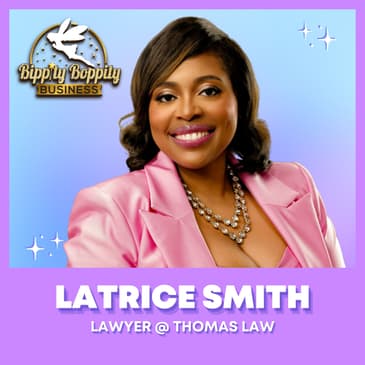
In this episode of Bippity Boppity Business, host Rita Richa sits down with Latrice Smith, attorney, entrepreneur, and founder of Thomas Law and Consulting, to do something a little unexpected: roast Disney's most iconic villains for their terrible business practices.
And honestly? The lessons are priceless:
- Latrice's journey from a family of healthcare entrepreneurs to founding her own legal + consulting firm [00:02:32]
- Cruella de Vil and the danger of high-pressure agreements — why you never have to sign what's put in front of you [00:07:45]
- When to seek legal counsel (hint: it's never too late) and what happens when you don't [00:11:14]
- Ursula's contract with Ariel — a masterclass in what's missing from most business agreements (consideration, defined terms, and whose voice exactly?) [00:22:11]
- Jafar and the Sultan: how to vet vendors and partners before they get too close to your throne [00:31:31]
- Genie's verbal agreement with Aladdin and what makes a contract enforceable [00:35:28]
- What "Day One" of building a business actually looks like — entity formation, service agreements, and knowing your exit strategy [00:38:07]
- Encouragement for entrepreneurs in the messy middle of the process [00:44:56]
Do you wish to connect with our special guest?
Connect with guest:
Guest LinkedIn: https://www.linkedin.com/in/latricesmithesq/
Website: https://www.nmsinc.co/
Tune in to every conversation about making magic in business on Apple Podcasts, Spotify, and Google! Leave a rating and review so we can keep making magic!
Listening on a desktop & can’t see the links? Just search for Bippity Boppity Business in your favorite podcast player.
Connect with Rita:
Visit her website: https://bippityboppitybiz.com
Connect with her on LinkedIn: www.linkedin.com/in/ritaricha
Do you have a podcast you want to create, rebrand, or grow? Discover Rita’s podcast consulting and production company, https://reignitemedia.onepage.me/
[00:00:00] Today's episode, we're going to take a wicked twist as we dive into the dark side of Disney. Everything's negotiable. So you don't have to just sign whatever somebody brings to this table. You don't have to just agree to the terms that are being presented. There's always room for negotiation. And if you don't, you might end up with a Jafar, so you better ask the right questions. Don't let anyone pressure you. You know, if you're not performing a brain or heart surgery, you know, it can wait. They can wait a day.
[00:00:25] No one makes magic and business like Disney. Join us as we hear from Disney cast members, influencers, and enthusiasts to uncover the secrets of what it takes behind the scenes to make Disney such a successful and well-loved brand. We will hear their journeys, inspirations, and have some good old-fashioned Disney fun along the way.
[00:00:48] So relax, pull up a chair, be our guest, and let's get down to Bippity Boppity Business. Hello everyone and welcome to this episode of Bippity Boppity Business, where we bring you magical business insights with a sprinkle of Disney fun. Today's episode, we're going to take a wicked twist as we dive into the dark side of Disney. I know I'm a princess girl, but we're going to go villains today.
[00:01:14] And we're going to dissect the business practices of some of the most iconic villains. And when I say business practices, maybe lack thereof, right? So this is a great episode because as an entrepreneur, we are faced with many decisions that we have to make, many agreements, partnerships, and we need to protect ourselves. So that's why I decided to bring on our fabulous guest for today. We're joined by the inspiring Latrice Smith, a lawyer, entrepreneur, business strategist, and general business Bippity Boppity Batty is what I'm going to call her.
[00:01:44] Latrice combines her passion for healthcare, law, all the business things that you could possibly think of with her just sharp business mind and her big heart for working with entrepreneurs and businesses. So let's all give a warm hand for Latrice. Thank you, Latrice, for being on the show today. Hi, Rita. I'm going to give you some confetti. Thank you so much for being on today. Looking at all the confetti in. Little bit of a clap from Snow White.
[00:02:16] So Latrice, again, thank you so much for being on the show. I'm really excited to just kind of dive into this topic. But before we do, I really want to have the listeners get a chance to know you and your story. So you have a really unique background. And you ended up in business law somehow, some way. I'm sure you didn't wake up one day and go, I'm a lawyer. I'm a lawyer now. So it's not that easy, you know.
[00:02:43] Tell me about your journey and how that led you to where you are now. Absolutely. Thank you for having me on your wonderful podcast, Rita, my fellow princess lover. Also a Disney lover and fan. Yes. You know, one of the 90s. So I got all the classics for you. Yeah. Yes. So a little bit about me and my experience. I'm Latrice Smith. I'm the principal attorney and founder of Thomas Law and Consulting.
[00:03:11] So we really hone in and help businesses and entrepreneurs build sustainable, scalable, and sellable businesses. So how do we do that? We do that twofold through the legal services, making sure these businesses are properly formed, have sound contracts, and also that they are having great strategic plans and strategic vision for their businesses. So that's how we work together with clients. And how did I get here?
[00:03:41] I come from a family of healthcare providers and entrepreneurs. I grew up in the pharmacy and in that environment. So I went to law school with the idea of being in a big hospital system and found out very quickly that wasn't my path. And so I developed this idea just really out of need for my clients to help the service-based professionals and medical providers really work through and build their business and their brand.
[00:04:11] So how can I assist them? They would have a lot of questions. I'd be helping them on the legal side and they have all these business questions. So I'd be able to found this idea to come up with a way to help with the legal, but also bring the consulting piece in as well. So it's worked out really well. People are always like, that's so interesting. And why hadn't anybody thought of this? So I'm happy to be a resource. And then I have great people like you that I refer them out to for special things and have partners and strategic partners to help them in their vision.
[00:04:39] So that's how we got here, the quick and dirty and a little bit about me. What makes you so passionate about what you do? Because to do this, you have to love it in a way. You can't because it's a lot. There's a lot of involvement. Business can be beautiful, but it can also be messy too. So like all of my clients, I feel like I have a part of each one of them's little vision in their business. So we truly become part of their team. We're their partner. We're their general counsel.
[00:05:07] So we're handed out all their legal, but still their strategic. And they're helping them come up with ideas, brainstorm their strategic plan, build those models out. So I really love it. I love hearing their vision and their ideas and helping them birth their baby is really what happens. So they have these ideas, but they are great practitioners, great with what they do, but they don't know and understand the business side, which I love.
[00:05:31] I might even kind of mention I didn't wake up one day and become a lawyer, but I'm telling you, I was like 10 and I had a suit on and I had a briefcase. I really did. So maybe you are. You are a little lady lawyer. I love business. I love the legal side. And I love helping people pull all the pieces together and seeing it come to life. It's amazing. It's a lot of fun. For me.
[00:05:56] Well, another reason really why I wanted to highlight you is I think there's a misconception about what law and lawyers look like a little bit and what that sounds like and what it's with it. And I'm like, I'm seeing you out here being a woman in business. And, you know, we're just like killing it and bringing your warmth and energy to it. And I think that needs to be celebrated, to be honest. So that's part of the reason why I only bring people that I want to be friends with on my show. So thank you so much for coming.
[00:06:25] Well, I appreciate that wonderful compliment. And I agree. I think people think about lawyers and that's why I love to have this space is because, you know, I'm very proactive so we can prevent disputes. I can come in and be. And if we're working together, we're thinking we can be proactive and prevent a ton of the misconceptions and bad experiences that people have in business. It doesn't have to be that way.
[00:06:50] If we're working hard and thinking through and have a strong strategic plan, we can really prevent a lot of those problems and things that come up. Definitely. Awesome. So let's get into the main like entree dish of why we're here. So I was we we kind of talked before and we're like, how do we teach people about law, about business in a way that's like just super fun and engaging? And we're here to roast.
[00:07:18] We're here to roast the heck out of some of these villains so that you can learn and hopefully not encounter any of these villains in your business life or. Absolutely. Right. So we're going to set up the stage with the first case. All right. So she's our lawyer. She's going to advise. Not really. These are fake characters, not real people. These are all her opinions. And it's not real. This is not legal advice. There's lots of. This is not legal advice. But we're pretending.
[00:07:48] And so we're going to start into the villainous venture of Cruella. Cruella DeVille. OK, so Cruella DeVille. Who is Cruella DeVille? I hope you've seen 101 Dalmatians for all of you listening to this. But she is basically like if you've ever seen the Devil Wears Prada, I feel like she's Miranda from the Devil Wears Prada. But for puppies. And like she has a really real relationship with someone that was like kind of her employee.
[00:08:18] But like kind of wants to be her friend. So the lines are already blurred like from the get go. So red flag. Red flag number one. But let's talk about what was going on with her in the movie. So if she were a client, you know, what are some legal red flags in her business of acquiring any means necessary that, you know, are kind of problematic? Because she basically puts people in bad situations. Like if you don't do what I say, if you don't give me all your puppies, everyone's going to die.
[00:08:48] Which is basically like an exaggeration. But it can feel that way at times depending on the agreements and contracts that you put yourself in as a business owner. Yes, absolutely. So Cruella, we've got a lot of things that we can dive into. But I think the one that you hit was that pressure that people feel sometimes when they're working for somebody that wants them to come in.
[00:09:09] And I think that her relationship with her, they had was it was a lot of pressure there for her to feel like, well, I've got to sell you my puppies. I've got to give you these puppies. But you don't have to sign everything. The very important point is, and especially if you feel like, OK, you're an entrepreneur or you're a smaller business or you're a new business and you've got this big vendor that wants you to do this. And no, you're not negotiating anything. That's not true. Everything's negotiable. So you don't have to just sign whatever somebody brings to this table.
[00:09:39] You don't have to just agree to the terms that are being presented. There's always room for negotiation. That's where having a general counsel and somebody on your team that's got your back to negotiate things, things are really extremely important. And so but that's the pressure is that similar type of pressure that we see happening in the movie is what you see. A lot of times when you've got a bigger vendor or somebody's pushing you to do something in business and you might not.
[00:10:06] They might you might feel like the contract and the terms aren't quite right, but they're saying this is a negotiable. That's not very rarely the case. So always make sure you've got some legal counsel, some business counsel on your team to help you really filter through. What are my options here? And everybody's on your time schedule. Don't let anyone pressure you. You know, if you're not performing a brain or heart surgery, you know, it can wait. They can wait a day. It's OK.
[00:10:34] No, you make such a good point, though, because I think Anita could have really used a lawyer on her behalf to discuss these things because she had to keep dealing with this toxic person like back and forth, back and forth. It was affecting her marriage with Roger because now Roger is like, oh, God, when's this lady just going to come over whenever and be in my business? Right. And I think that's that's the that is a translatable situation to what happens when you don't have the right counsel.
[00:11:02] It not only affects your business, but it can affect your life. And maybe you could even affect, you know, relationships, family, marriage and beyond. What is the mistake that you've seen that people, you know, when they maybe like when should they seek counsel so that they don't have that mistake? You know, like when is it too late to really like find that counsel for your business? I think that's kind of a two part question. If you are running a business and have one, you need somebody that's helping you review your contract.
[00:11:30] So if you're a service based provider, you need to have an agreement that reflects the services that you're providing, that your clients can understand their roles and responsibility, their terms. Those important ones like payment terms when they're late, when they're due. But you want you don't want just that template off of Google. You want somebody that's an attorney that's going to take the time to learn your business and your business needs and really provide a document. That's going to be great to represent your business, but that your clients are going to also be able to look at and understand.
[00:11:59] So that's where that's going to be extremely important. And you need a lawyer for those service agreements. If you're leasing a space, you don't want to sign a lease without having an attorney review it. If you are going and signing a contract with a new vendor, just because they're providing you their contract doesn't mean you have to sign it. It can be negotiated. And when is it too late? It's never too late. If you're still doing business, ideally the best time is before the contract. But if you have a dispute based on the contract, you can bring counsel in.
[00:12:28] That's a big part of what we do. Sometimes we run into clients, unfortunately, after things have happened. So we are helped with dispute resolution. But that still doesn't mean we're going to look at the contract. We're going to review the terms. And that doesn't mean you always have to go to court. Sometimes if you bring an attorney in and help negotiate, even when there's a dispute, everybody kind of levels the playing field a little bit. People start to be a little more reasonable when the attorney is talking to the attorney versus you.
[00:12:57] So even then, it might not be too late. We look at the terms. We talk about them and really understand and hear the help and be your general counsel through the process. If it's from day one or dispute, we work through that and kind of come up with a solution to the problem. Right. So how would we have helped Anita out? Like if we sat her down like girl to girl, be like, listen, I know Cruella is she's not trying to she's not giving you a real contract, but she keeps trying to tell you that this is a business deal.
[00:13:25] And she's going to give you so much money as long as you give me all of your puppies and she won't let up. Like how what's the first thing you would tell her to do? So first thing is we need to understand those terms. So the real terms and the real intentions was to kill the puppies and make coke. Right. So that's not something that Anita was going to be wanting to do. You know, you're just saying, oh, I'm going to take these puppies and everything's going to be rosy and you don't have any room for them. But she really wanted to kill them. So we need to really understand what we're getting ourselves into.
[00:13:54] That's where terms are very important. And the roles and responsibilities, who's going to do what when? Another big piece that we want to need to want to be looking at if we had a contract there would be, you know, what are the breach terms and what are the terminations? You know, when is enough enough? When it is not? Some other important terms, if they could have worked something out and everyone been reasonable, would have been, you know, when is payment due?
[00:14:22] So let's say they had, we weren't killing puppies, but we might have been selling antique furniture or something that they had in their cute little apartment, in their cute little brownstone. And she said, okay, I agree that I'm going to let you auction my furniture off. So when am I going to get my money? What's due? How? What are those terms look like? And when do we want to have you do this? And so those are other important things that we want to make sure. So terms of the contractor, who's responsible for what? When are we going to pay?
[00:14:51] Can I get out of this and how? Those are kind of key boiler material. We call them material terms that everybody wants to be clear about. They can be negotiated and want to have outlined. And then you want to have outlined for entrepreneurs when you have your clients. So let's minimize conflict and disputes with your clients. I want to highlight that because you can preemptively minimize conflict and dispute if you know the scope of the work you're doing.
[00:15:19] And then you have the proper agreement to highlight in writing that that's exactly what you're going to do. Because it also can help protect your reputation as well. So if somebody tries to come at you and say like, you know, and you know, I heard that Anita sold the furniture, but you know, she didn't pay as much. She wasn't doing a good job. She wasn't a great client. She didn't pay as much as she should have or whatever.
[00:15:44] You know, if I'm Anita, I can come back and be like, well, per my agreement, I actually did. And when I sell furniture out of my house, this is actually what I always do kind of a thing. So what are your thoughts on that? Absolutely. That's extremely important. And it gives everybody an opportunity. And then even you're more of on the strategic side of what we do is when you have that contract, we have scripts and conversations and we role play and practice. How do we present this information?
[00:16:14] Because most people don't read. If we run businesses, we know that. So we want to have those conversations. If it's going to be at the consult and somebody says, yes, I want to move forward. We want to say, hey, you got in section A, here are your terms. Another huge one is their responsibility. So I had a non-Disney character client that came to me and she said she wasn't able to perform her end of the contract because the client hadn't provided the things she needed for her to perform.
[00:16:44] So those roles and responsibilities become extremely important because, you know, my time clock can't start if I'm expecting you to, I'm doing your marketing and we want to market this great furniture. But I need you to send me pictures of it and you haven't sent me the pictures I need. Well, I can't, my time clock for marketing hadn't started because you hadn't delivered your part for me to market the furniture. So those are the important pieces of roles and responsibilities we want to make sure clearly outlined because that can kind of create conflicts.
[00:17:13] Like you told me in 30 days we would have this bag and you'd be providing me data on this. Well, I wasn't able to put them, put it up because you didn't send me the pictures until 15 days into the contract. So 30 days didn't start until November the 15th. So you would get your, so those are little nuances that we work together on the strategic side that overlap with the contract. It really helped prevent disputes. So I'm loving this because I want to imagine that Anita actually came to you.
[00:17:42] She's no longer having to deal with the puppies. We're going to go with the furniture in her pretty house and like London or wherever she's at. And you're actually her lawyer and she's already had like everything outlined the way that she needs to. She is a little bit of a people pleaser like I am. I can tell she's kind of like, oh God, conflict, get away. Yes, I love you. Bye. I actually hate you, but I don't want to say anything to like ruffle your feathers.
[00:18:03] You just mentioned you do coaching on not only the, like, not only like the service of the contract and the legal advice, the legal service on that, but like coaching on how to actually communicate through those terms and be like confident in what it is you need to say. So how would we give advice to Anita? What would we coach her and, and the ways that she's presenting these terms and conditions? Like how should she go about like confidently saying that?
[00:18:33] Absolutely. Practice, practice, practice what they've been telling us since we were five. It truly is. So coming up with that part of that strategic plan is building out scripts. So that's for you as a business. You know, your business, you know, so part of building out scripts is coming up with objections. What are questions that people are going to ask? What are going to be their objections to closing? So we work through having blow by blow scripts and knowing how we want to present the information so we don't miss everything. We ensure that things are as clear as possible.
[00:19:02] And then especially when you bring on teams, the idea when we start business is not for us to be doing the work forever. So we're preparing to hire new team members and give them the things they need to be successful. So that's a huge part of what we do is really focus lean into what's your client process and your client experience and how do you talk to them? How do they know? What are we presenting? And that's a big part of that strategic planning, ensuring that that contract is we again. Yeah, we want to have a great contract. We can get that done.
[00:19:32] And that's essentially how the consult inside the business came up. But how do we prevent that dispute? If yes, in the contract, but I'm not reading it. I don't understand it. And so presenting it in a way that, hey, this is what the expectation is. You can review section A. You can review clause two and make sure you understand if you have any questions, give us a call. But this is what's expected. And when you're expected, I've got to have those pictures by this amount of time before we can start or it's going to delay the process.
[00:20:01] We draft the contract in a way it's not built on dates, but days from the time I receive things. So those are little small nuances that seem small, but they minimize problems and disputes later in the relationship and help build long-term relationships and great referrals.
[00:20:18] I really want to highlight that you mentioned it also helps grow your team because I never considered personally that you can have statements that handle objections that are not just what that individual helping you, your team member thinks is the best way to respond. But it's like the standardized way to respond taken from the contract that withstands and upholds the integrity of that relationship. Absolutely. I never thought of that before. That's so cool.
[00:20:48] I need a lawyer to tell me how do I tell somebody no. Like, that's what I need. Yes. And not just you. And you're going to get great at it and you're going to have lots of clients. Then you're going to have to hire somebody that can do the same. Exactly. So that's a huge part of it. And so if we work through and we're building out the processes and scripts and strategic plan, when we hire these amazing people, they may be great over here, but they might not be so good at saying, no, we can give them the tools they need.
[00:21:15] Or they might not be as quick on their feet and unknown to say in those objections or still learning your systems. They've got what they need. Oh, that's that objection that sounds like that. And they can go through and say, I've got the tools I need to be successful and close this client, make sure the client is happy. And so that helps us if we do it on the front end and we're creating this as we go along. When we bring in new people, then we know, hey, they got the processes they need to be successful as well.
[00:21:44] So let's take another trip to another part of the Disney universe. I think we I'm glad we helped Anita. She's confident now. She doesn't have to deal with puppies. She's selling furniture. She's rich. Her and her husband are happy. Nobody's bothering her ever again. She's protected. So let's go on to the next universe. Let's take a look at Ursula. And the reason why I want to bring up Ursula is because she actually has a legitimate contract that's featured in the animation.
[00:22:11] And in my opinion, it's what contracts can look like if you pull them from Google and make a template from Google and what can happen. That's it. We do not want to. We do not want to. Business owners do not pull your Google contracts. We want to make sure your contract is reflective of you and your services and your intentions. Right.
[00:22:31] So there's a few like ethical and legal like manipulations that are happening here because in the contract, I'm going to go ahead and pull it up so that we can see it together. Okay. Okay. So here's the contract, right? Go ahead, lawyer. Let's have the lawyer read the contract, the very final contract. All right. Hereby grant unto Ursula, the witch of the sea, one voice for all eternity. And we've got some fine print there.
[00:23:01] And we just are really not sure what that says. But that's exchange for something, high daughter something. We don't know. We don't know. We got some fine print. We don't like that. We need to know what this is. No Latin and all eternity signed by Ariel. We missing a lot of stuff in there. We missing a lot of stuff in this contract. So Ursula's statement to Ariel. Okay. We're in, we're in sea court now. Ursula's statement to care to Ariel is, Hey, I know you have the hots for the human guy.
[00:23:30] So you're an, you're a mermaid. You can't be with him unless you become a human. So what I'm going to do for you is I'm going to make you an awful. You can't refuse. Basically. You're going to have your legs and you're going to have human legs and you're going to be able to keep them as long as you kiss your dream lover guy by like the third day or whatever. Right. So she says all this to her and she says, as long as you give me your voice. And then she takes Ariel's voice and then Ariel signs this while she's like singing it out.
[00:23:59] But here's my question. Okay. To my, to the attorney in the room. First of all, what is the first thing I'm seeing something wrong here? But what's the first thing that you see that that's wrong about what she says and what we see on here? Well, we've got a lot of terms missing there. So all our Ariel is granting here is her voice. It doesn't say on which contingency she's going to get it back for how long.
[00:24:26] Based on the terms of this agreement, she's got it in forever. There are no exceptions. But the reality of what Ursula was describing was an if-then clause. So if you perform and do X, Y, Z, then X, Y, Z happens. And so those are contracts that are valid if it had been in writing. But so we've got a couple of different conflicts. We've got a conflict versus what was said and what was done.
[00:24:52] So when we go to enforcing this contract, what do you think is going to be the enforcement? What she said or what's in writing? What's in writing? And also another question. Is this a loophole? Because I like to pretend I'm a lawyer because I watch Legally Blonde once, but I'm not. It only says one voice. Does it specify that it's Ariel's voice? Could she have provided any voice? Well, that's a very good point.
[00:25:19] It does say one voice and it does not specify whose one voice it would be. Right. Technically, if she could have come up with another voice, she would still be in the terms of her agreement. Right. So specifying terms is important. Absolutely. Because that would have been clear.
[00:25:37] It would have said, I hereby grant unto Ursula my voice or this voice or Ariel's voice with her full name and LLC and address would have been nice. Right. So those are the things. Those are key terms. We'd like some dates. Eternity is a long time. I like them. Yeah. Like what is eternity? We don't want it. Like really, there's some real defined terms here.
[00:26:05] Could we argue what eternity means depending on where you're from and what that looks like? What does eternity really mean? Like what is the length of eternity? Right. It means that once this happens, it is done. So I would venture to say eternity might work because there are some contracts that once it's done, it's done. It's done. That's why we have performed, it is done. But again, we're not very clear on who, what we, and so when you have a contract, you have an offer,
[00:26:34] acceptance. And so what the, the other piece is missing is the consideration. So both parties, somebody has to give something. So what Ursula is giving to receive is not here as well. So that's a very important piece as well. So what is Ursula going to give as consideration for what Ariel is giving in return? Is another big piece that's in a contract as well. That's the payment usually. That's so interesting.
[00:27:02] I'm like, can I be Ariel and be like, actually, Eric and I didn't work out. I'm going to come back and like fight you on this. And yeah, you only said one voice and you didn't tell me like what you needed for it. So I'm entitled to my voice. So I'm going to fight for my voice back. She didn't say what she was going to give her. Right. So the idea in the movie was she was going to give her legs is what she was getting. Right. In exchange for this voice. So she's going to get to keep these legs if she got her kiss. So we don't have no kisses. We don't have any legs.
[00:27:32] We're missing a whole lot of pieces in this contract. And you know, it's actually one last part I want to highlight on this that you might think is amusing. I think on the business owner side, if this were my contract, I think there are people that make the mistake of making one type of contract from a Google template and then they reuse it for every single person. So this looks like it's templated for literally every little C client that she had come in. All they had to do is sign up their name at the bottom.
[00:27:59] So she's thinking she's she's thinking she's an efficiency queen because C witch or whatever. But like, why is that harmful? Well, that is because, you know, we might have it depends on who she's dealing with. You know, she might have some clients that she's taking voices from that already have legs. They might not need legs. So we need to be clear about what those terms are. When payment is going to be due, she might not want their voice for eternity. She might just need it for a short period of time. Like a week out.
[00:28:26] Just wait, you know, so specifying those and having clear for different services that you're offering in different terms are very, very important. And sometimes we do it by having a base contract. And then we might have exhibits that have things like scope of work outlined in them and things like that. So we can minimize the back and forth for the need for a new contract. But again, those are things where you really need an attorney to say, OK, what needs to be in the base agreement? And what can we bring over to the exhibit each time? And when is this appropriate?
[00:28:56] So that's where having counsel is extremely important. Let's talk about, you know, a scenario that you could see potentially happening where like in real life, you don't specify who, but like from your work, what is the situation that you've seen happen where someone didn't have a proper contract and they used something templated and it came back to bite them in the behind, unfortunately? Yes. We kind of started talking about it earlier. I think it was a good one.
[00:29:24] I had a client that was a mark. She was in marketing and she had someone that was going to hurt their plan was they were demanding their money back because they felt that their services hadn't been properly rendered. Well, after a close kind of review of the agreement, then she is like, well, you didn't kind of specify when your turnaround times would be. That's important to have clear when certain things would do.
[00:29:50] But the bigger piece that was kind of holding up, she needed approval from the client for various things throughout the process because this was an ongoing engagement. So she didn't receive the first piece in time, which was the photography that she needed. So that delayed. Then once she got everything prepared, the contract did require review, but it didn't stick to the timeframe. So in that scenario, I would suggest that we'd say upon receipt of documents, if not
[00:30:16] reviewed and approved within five days, I would assume that it is approved and we'll move forward with our process unless I hear otherwise. And so though, or understand if you don't approve that there will be a delay and we're not responsible for any of the delays, but you are still responsible for paying. So those are things that we put in the, that's an example of a way I would have kind of fixed that for her to make sure if you've got ongoing engagements and the client has responsibilities
[00:30:44] that's going to hold up your progress, that they make sure they understand that, hey, I can't, but those are the kinds of things we want to talk about in our script too. We don't want to say that we want it in the contract. So it's in writing if we have to enforce it, but we, that's something we really want the client to understand that this is the process and we can't do this without your complete engagement in this process. Awesome. So we're going to move on to the last portal of Disney animation.
[00:31:13] We're going to go to the movie Aladdin and there's a couple, there's a couple characters that we can talk about. I want to start with Jafar. So Jafar is known for being like super manipulative. He does like backdoor deals. He's trying to grab power and he's really just like in it, but not for the right reasons. But when he advises the Sultan, the Sultan has no idea that this guy who has all this power and seemingly like more power somehow than the Sultan is doing all these things.
[00:31:43] So what would you say are the big don'ts from a business law perspective for someone like the Sultan who has to work with a Jafar? Absolutely. So that's a very common thing because sometimes the people in power at the top might not always be the most savory characters. So the first piece is really doing your research. And so this is, I'm going to lean more on the consulting and strategic side about how I help clients is when we're looking at new vendors and potential partners, we have a series
[00:32:12] of questions just like if we were hiring somebody because yes, they're going to be our partner in providing their services, but we want to know that they're going to be a good fit for a long-term relationship. So I want to know what are your processes? I'm asking the right questions, but when I'm working with my clients and I'm their partner, we spend time when we're hiring vendors, what are questions we want to ask? What are things we want to know to really get to know who I'm going to be dealing with? Am I going to be dealing with you? Do you have a team? Will I have my own account rep?
[00:32:40] How often will they be communicating? So these are questions. So when we take all of our vendors and we've got our questionnaire, we can really compare apples to apples. Well, vendor A said X, Y, Z, vendor B said C, and then we're able to do our research. So the second piece is really not just taking somebody you met at the networking event and going down a whole partnership. Or at the bazaar, you know, you walk down the bazaar. Exactly. You know, you're in the gold market.
[00:33:09] You know, you can't just, that's because they've got a booth there doesn't mean they're doing great business, you know? So you really want to take some time to get to know these people asking the right questions. We have Google, we have Instagram, really understand how they do business. A Google search, they have bad reviews. So taking those, the time that's the big role of an owner and the CEO and the founder is to
[00:33:35] do those type of legwork and deep dive into those relationships and not doing sometimes where business owners get out caught up. They're doing small tasks that they can hire somebody great to do for them where they should be kind of understanding and develop that relationship and doing their research over here. So the lot of pieces there to really help strengthen that and make sure who you're doing business with is the right person and they, they're in line with your vision and goals. That's, you said so much.
[00:34:02] That's very important in such a short time that I just want to like double down on it because it's not the fact that Jafar was, you know, so bad and he was ruining Sultan's life. Like that was like the part that needed to be fixed. Like you're saying it could have been fixed even before that, like the Sultan could have taken more time to sit down and figure out as his advisor, based on the questions that you're providing and the thinking points that you're providing, who will be the best person for that.
[00:34:33] And then a contract maybe becomes a little, uh, not easier, but more streamlined to produce if you have that first like tier out of the way, right? Like, you know exactly who, you know, your mission, you know, your values know why you're doing it and then that's where the other stuff comes in. Absolutely. And when you start asking people questions and, and part of what we really, not just asking questions, but asking very specific questions to understand the heart of how people do business and handle things in bad situations, ain't good ones.
[00:35:02] That tells how they've handled situations in the past really can tell more about them. They could sit there for hours and tell you all these things, but if they can't tell you real specifics about how they handled things in the past, that's really your insight into who they are and what you're going to be dealing with and how they're going to react and deal with you. And if you don't, you might end up with a Jafar. So you better ask the right questions. That's right. Who you're getting in bed with, as they say. Right. That's right.
[00:35:30] On the flip side of that, we have a positive character. We have Jeannie in Aladdin and Jeannie and Aladdin work together. He doesn't really make a lot and sign a contract, but we're going to pretend when Aladdin, like, you know, found the lamp and then like, you know, made it come to, made Jeannie come to life. Like that moment was the contract moment. Okay. So we're going to pretend that, but Jeannie basically says you have three wishes and you know, you can wish for anything you want, but insert clause. You can't bring people back from the dead.
[00:35:59] You can't make people fall in love with you and you can't wish for more wishes. Now from the business side, what's the good, like dive into the good business practice on that from your end. Absolutely. So first thing, and another important piece is you can't have a contract with someone that is, you can't have a contract with someone that is verbal. There are verbal contracts. So, but the tricky part with verbal contracts and why we don't like them and they're very
[00:36:28] hard for us is we have to prove and agree on what those terms were. So when it's verbal, we just, unless there was a recording or somebody else heard it, which comes here to say, it gets very tricky to determine what was real in the agreement and what, especially if there's already a dispute. So that's why we, especially as business owners kind of steer away from that, but you can still have a contract with verbal. If you've been recorded at the Disney studio. Yeah. Yeah. We've got, we've got evidence at that point.
[00:36:57] So we've got, we've set out, these are the terms of the agreement. So yes, I'm going to provide XYZ services. You've got to provide XYZ services. And these are the contingencies in which you have to do it. And so some people will try to, because if they want to do one of those things, but still keep the agreement, let's try to get a role, have found a way to get around it. And the question comes, are we in breach? Did you abide by the contract terms?
[00:37:24] Or did you go on a different direction, trying to get around it, make the contract void or avoidable? So those are kind of some specific things when you have kind of, if then clause are contingencies to the agreement, at what point is somebody responsible or due to perform their part of that agreement? So those are some important pieces there for him.
[00:37:47] So if, if Jeannie, um, let's say Jeannie came to you and he really wanted to pull, he wanted to make a whole plan from like the beginning, like you're like your whole service that you offer, right? Like step one, he's like, this is my day one of being a Jeannie. So if he's day one of being a Jeannie, what's the first thing he should do? Yeah. So the first thing Jeannie is going to do, we're going to get Jeannie proper formation. He's got to have the right formation and we've got to make sure his entity is sound.
[00:38:17] So when the IRS comes, let's see, were they in Abu Dhabi? We got to find out what country they're in. I'm sure they've got some kind of, um, they've got some kind of organization formation. So we've got to make sure that his organization is properly formed and recognized by whatever government he's in. That's very critical to ensuring that if we say he was in the U.S.
[00:38:40] Um, that he did have a LLC is usually going to be a good for depending on the long-term goals. If it's an organization you plan on taking public or getting funds for a corporation, it might be a better suit, but those are things that you discussed with an attorney early on. And really the long-term goals depends on that, but that's the first piece. Um, the next piece is really understanding what type of services do you want to provide? Um, what are we going to list the services we want to provide and which ones don't we want to provide when people come ask us for them?
[00:39:09] Um, how much we're going to charge for those services? And then, um, when are we, when are we due payment and how much it's going to cost to offer those services? So how much we're going to charge and how much it's going to cost? Those are the kind of neat key pieces. Then we start building out that contract. You know, when do you want to get paid? What are the roles and responsibilities going to be? Um, what are those if then, you know, what are those exceptions to performance that are going to be in there?
[00:39:36] Um, what are the expectations and roles and responsibilities of the party? So those are those key things. We want to make sure they've got a proper services agreement. Um, he did have some space that he owned. We got to find out if he's owning or leasing that space in the, in the bottle. So if he's leasing his lamp, if he's owning or leasing the lamp. I need to know those terms. So I'm going to look at that agreement, you know? So I decided, you know, he does have terms there. He's, you know, he can, he can live in that lamp and have those powers, but he can't, he doesn't have freedom.
[00:40:05] He has to be, he has to stay in that lamp. He can't go anywhere else. So, you know, if he plans to get a new lamp, if we've got some new lamp options, we want to go look at, we need to make sure that lease is strong and sound and that we establish how many square feet that's going to be needed. Um, can we buy, um, do we have money to do that? So those are kind of key pieces when I'm working with a client that I'm kind of really establishing about their business and that are going to be important when we start our new genie business as well.
[00:40:34] And branding wishes. Well, I mean, let me just say how awesome of a service is this? Because I am sure, like you said, there's many pieces to the puzzle of starting a business that somebody doesn't even know where to begin. What needs, it feels like a lot of these services are siloed, right? Like I get a contract here. I got a trademark here. I get this here. I get this here. And then it's like, but wait, what do I do with all of this? Kind of. Absolutely. Wow.
[00:41:05] And that's why Thomas Law was created in the way it was, was really to say, okay, we can be your holistic approach to your business needs as far as planning, trademarks, your business needs, forming your organization. So we've got you on the business transactional side and strategic planning side. We've got you covered. And then we bring in those other people and specialists to support us throughout the process. That's amazing.
[00:41:31] So, you know, we talked a lot about different villains and different, you know, kind of cases here, if you will. Yes. So what's the one key takeaway from all of those villain stories that we went through that if an entrepreneur is listening, they should absolutely like digest and pull from the conversation? Absolutely. So I would want to say we have counsel is extremely important. So we offer services to clients. We're general counsel.
[00:42:01] So we're your partner and we make it a way that works for you and in your needs. So having someone that you know, understanding that those contracts are negotiable, that you don't just have to sign anything, that there are ways to when you're working with your clients to ensure that you're protected, but you also have a great working relationship. And it starts from that moment, you really that intro meeting. But really, when you start that contract, you start the relationship and you're setting
[00:42:27] the tone for how the relationship is going to move forward and how many great referrals they're going to send you. So those key critical moments. And another one we didn't get to spend as much time on, but that's extremely important. It's going to be thinking about your exit. What's your long-term plans? Mm-hmm. So, and that's going to think about formation. You know, if you're thinking of keeping it, the LLC might be fine. But if you're thinking about going and raising capital or IPO, you really want to be thinking about forming a corporation. So those are critical.
[00:42:57] Those exit strategies. So that might be another one we might have. We're going to have a follow-up. I think we're going to have a follow-up on that. Yeah. Yeah. So those are kind of the critical things I like for my clients to be thinking about early on and working through how they're going to work with clients, their exit, proper formation, and their services and how they're offering those services. So what's next for you in your business? Like, where are you at now in your own journey? Okay.
[00:43:25] We're going to put the spotlight back on you as my guest. Like, what are you looking forward to and what are you really excited about? So that's a great question. So we are planning our events for next year for 2025. So I really think about what events we want to go to. I'm working on a course. So a lot of these great features that we've talked about and kind of shared with your audience,
[00:43:49] really wanting to put that in a digestible at-your-own-pace format and creating that resource for everyone to be able to touch regardless of where they are on their journey. They can take those pieces that really resonate with them and really deep dive into that. So that's our really big, huge next push is to be out in the community more sharing this information. And then, too, to really have that course and options of libraries and information for people to utilize.
[00:44:19] That's so amazing. I can't wait for everything that you come up with. And, you know, I want to wrap up with just like more of a personal question because I think people can hear you talk and, you know, feel like very educated and maybe entertained by what we're saying. But for someone that is going through the hard time of whatever situation that they're in, maybe they're going through some kind of dispute that they're going through in their business or, you know, some kind of legal whatever.
[00:44:48] They're just going, there's a hard time in their business. What kind of encouragement or advice would you give to that person to help kind of lift them up out of it? Absolutely. It is really part of the process. So that if you look at any of the greats that have done it in our lifetime and beyond, if that be Warren Buffett or Jeff Bezos or any of them, they all talk about that part of the process. And we'll call it a struggle, but I don't even like to call it a struggle.
[00:45:18] It's just the necessary learning pieces. So don't think you're alone or this is something you did wrong or I could have done this better. Don't worry about the regret. Take the lessons. Learn from it and keep moving forward because it truly is for every, if somebody tells you they haven't been through it and they went through that process, they're not telling you the truth. Everybody that truly shares their story talks about how hard it was to raise money, to get to the next phase, the struggles they had with employees.
[00:45:49] I love, one of my favorite is Howard Swartz Onward. He's the Starbucks founder. Well, not founder, but he's what made Starbucks with this. But he talks about things like the smell of when they decided to have food, how the smell would fill up and it didn't smell like coffee anymore. Like it's a coffee shop and it smelled like coffee, not burnt bread. So, I mean, it seems like that. And you get bogged down in business. It's like, how am I dealing with this? But they're so critical to the business. And so you have to dig.
[00:46:19] So everybody's going through that. Everybody, you don't just walk into the Starbucks and imagine you smell coffee, you're not burning bread. Somebody literally had to think through all of those pieces. So just understanding. And I guess the best way to do it is take some time, audiobooks, reading podcasts, doing things like this to really understand that everybody has to go through the process to get where they're going. You're going to have no way to predict everything. There are a lot of things you can be proactive about to reduce some of that headache.
[00:46:48] Yeah, I mean, lately I've been saying, you know, inspired by Disney movies, we're all on our own hero's journey, right? We're going to face the villains. We're going to face the giants. We're going to go through the conflict. And then at the end, you know, we'll hopefully be triumphant in our own business and life too. I want to ask you also, because there's like the little Disney angle to this. If you could go back and tell the like 11 year old version of yourself who was so excited to be a lawyer,
[00:47:16] like what you're doing now and what advice you'd give her, like what would you tell her? Oh my gosh, probably the same advice I just gave everybody else. I honestly would. It's the process. You're going to go through ups, downs, lean into what you know is right in your vision. Just keep going. I would probably say have a little more fun. I got to probably in college, like some people do a little Tuesday, so enjoy the process. Don't just go through the process, but enjoy the process. So that's what I would tell 11 year old me.
[00:47:46] Have fun, go through the process, lean into what you know, but have fun. Yes. Yeah. So I'm having fun with it now. Like talk to you. Yes. That's exactly why we do this show. Absolutely. I love it. So, you know, that really wraps it up for today's episode of Bippity Boppity Business. I'm looking forward to our continued relationship and maybe some follow-up episodes. I hope everyone listening enjoyed the little mix of just business lessons, some magic,
[00:48:14] and a few like laughs along the way. But Litris, thank you so much for sharing your wisdom and helping us to see these villains in a new light. For everyone listening, remember, okay, here's my key takeaway. Good business is all about making the right choices, learning from others, both heroes and villains, and like you just said, and hopefully enjoying the process along the way. Until next time, I hope you all have a magical day and keep building your own happily ever after. Thank you. Thank you.
[00:48:43] You've been listening to Bippity Boppity Business. Like what you hear so far? Leave us a review in Apple or listen to us anywhere you prefer listening to your podcast. Until next time, have a magical day.